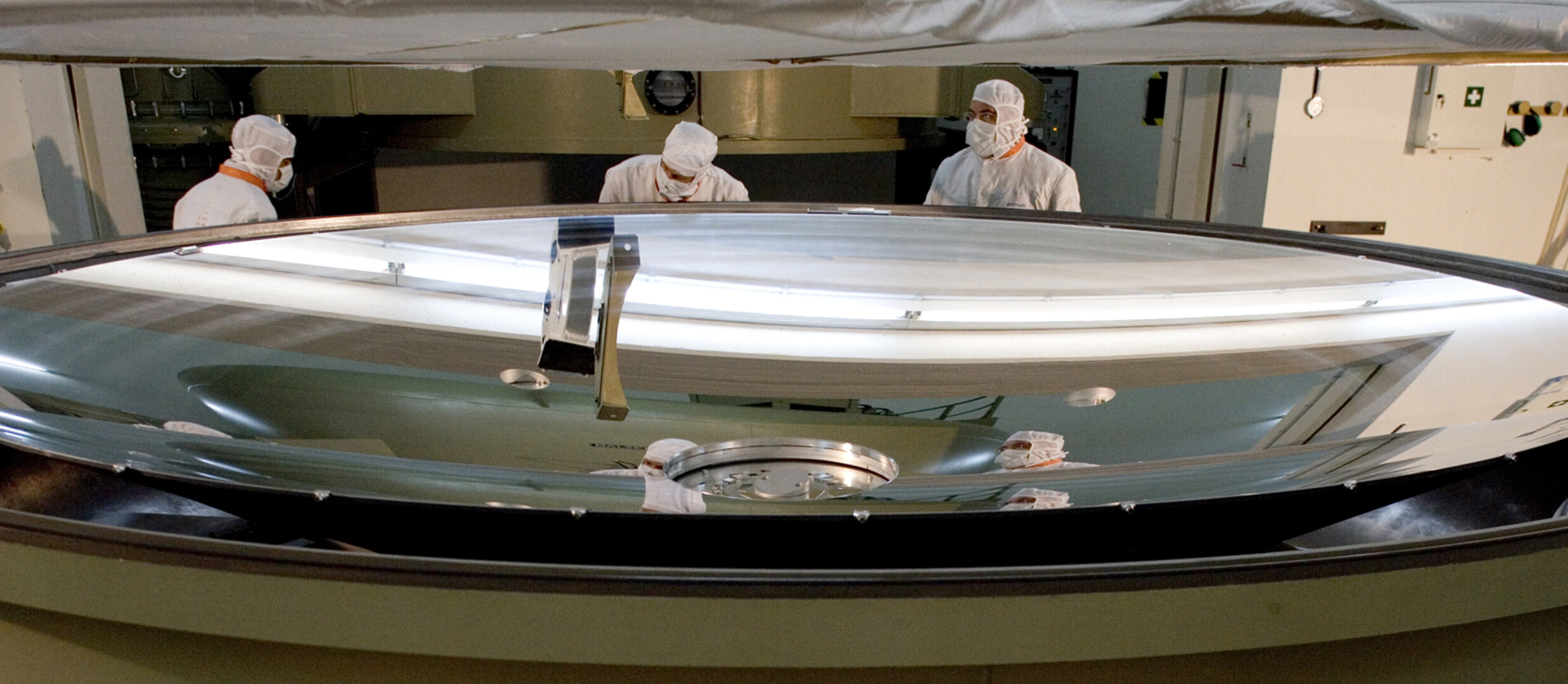
Hubble, green with envy?

Collapse
X
 
  • Time
  • Show
Clear All
new posts
  • Brian Ellis
    Super MURCer
    • Sep 1999
    • 9623

    #1

    Hubble, green with envy?

    The largest telescope mirror ever built for space, due to be launched on board ESA’s Herschel spacecraft in 2007, has completed its assembly and first testing phase.


    The Herschel space telescope has now had its optics assembled with a mirror 212% larger in area than Hubble, with a weight of a fraction of Hubble's.

    It will be used mainly for long wavelength IR research, with its sensors cooled to only ~3 K (~-270°C), a field in which Europeans are already leading.
    Brian (the devil incarnate)
  • Fat Tone
    Super MURCer
    • Aug 1999
    • 7579

    #2
    Let's hope they painted their interferometer properly!
    FT.

    Comment

    • Kooldino
      Super MURCer
      • Nov 2002
      • 3026

      #3
      About time someone besides the US did something big in space lately.

      So how is the mirror involved in the telescope?

      Comment

      • Nowhere
        Super MURCer
        • Jun 2002
        • 4830

        #4
        Oh c'mon Kooldino, Huygens was european

        And perhaps not very spectacular, but keeping ISS alive in the absence of Shuttles is quite big IMHO

        Comment

        • cjolley
          Super MURCer
          • Aug 1999
          • 7672

          #5
          Originally posted by Brian Ellis
          ... with a mirror 212% larger in area than Hubble
          Oh no you don't
          Resolution?
          If it focuses a longer wavelength doesn't it NEED a bigger mirrior?
          And not need as much smoothness and (insert word for the "flatness" of curved surface here) ?


          PS Not to not say congratulations and thanks for the contribution to science.
          Chuck
          秋音的爸爸

          Comment

          • Brian Ellis
            Super MURCer
            • Sep 1999
            • 9623

            #6
            From what I've heard the optical resolution with visible light is state-of-the-art. The mirror aperture is the same for all wavelengths. I agree that for long IR the precision may be less important than for visible light, but ±2.5 µm over 3.5 m is pretty good (better than 1 ppm error!). I don't know what proportion of time will be used for visible, near IR and far IR work, but there is talk that it will detect water and organic molecules in far-off galaxies with the far-IR transmissions.
            Brian (the devil incarnate)

            Comment

            • Dr Mordrid
              Moderator
              • Apr 2001
              • 26592

              #7
              The optical scopes do a poor job of looking into the universes "dark ages", which is to be the focus of most new research.

              Enter JWST.

              Dr. Mordrid
              Dr. Mordrid
              ----------------------------
              An elephant is a mouse built to government specifications.

              I carry a gun because I can't throw a rock 1,250 fps

              Comment

              Working...