Announcement

Collapse
No announcement yet.

Peak cheap oil was reached in 2005

Collapse
X
 
  • Filter
  • Time
  • Show
Clear All
new posts

  • Peak cheap oil was reached in 2005

    As per Nature.

    Hopefully this will wake up some politicians to stop pushing useless crap like CO2 emission trading (which the financial sector and their sock-puppet Al Gore would love us to implement) and CO2 sequestering. The Germans seem to realise that their excessively high feed-in tariffs are not really the most affordable way to tackle the problem of reducing dependency on oil and nuclear power.

    Instead, what we need is a huge effort to increase energy efficiency of our industries and rest of society. We need to do research on how to achieve that without big spending on implementing current technologies that just don't cut it as a replacement for oil and nuclear (i.e. solar, wind). The former especially not on latitudes as high as Germany.

    Japan is an interesting case study for the above, as it is even more dependent on energy imports than Europe is. I've heard that in Tokyo you can only get a parking permit if your engine size is smaller than X cc and your car also meets strict size regulations (this was done to solve the traffic queueing).

    Improved public transport in areas with high population density will likely also get more emphasis again. I've heard plenty of stories about trams running in many smaller towns in continental Europe in the beginning of the previous century, which now have disappeared and made way for asphalt and cars. A reintroduction of this mode of transportation seems not too far-fetched to me.

    In the US, where population density is much lower, this problem is harder to tackle. The lack of petrol tax will allow a lot of improvement in car engine efficiency (as they severely lag in adoption of fuel efficient cars compared to the rest of the world). I think in the longer run, it's a given that rural villages in Northern America will slowly turn into isolated communities though.

    In line with the findings in the referenced article, the wars in the middle east, including current build up against Syria and Iran can hardly be considered surprising. Control over energy resources is likely going to get a lot more bloody when they get more valuable over time.
    Last edited by dZeus; 8 February 2012, 08:56. Reason: small edits and additions

  • #2
    this is a reply to Utwig's questions in the other thread (about Die Kalte Sonne):

    What do you think of future and energy?
    - I've mentioned some effects in the first post
    - Energy usage will take a much bigger chunck of our budgets (of the western world) in twenty years
    - Mobility will decrease (small rural communities that are 50+ km from the nearest city will get a lot more isolated)
    - The biggest gains (in the western world) can be made by reducing energy waste and improving energy efficiency, not by spending big $$$ on biofuels or wind/solar right now
    - some sustainable energy technologies show promise for the future, but need more research or higher sun intensity than what is available at the latitudes of northern europe. Right now, thermal sun and to a lesser degree PV makes sense in mediterranean countries. Pumping money into PV in Germany like they do right now is an absolute waste (imo).

    I think there's plenty of food, even with less oil. African people might have to pay a lot of money for their food (as you predicted). This may lead to some anger towards the countries where they export their food to (western world and China mainly). If they start to organize themselves that is. Africa unfortunately has the historical fate of getting raped by us of their resources over and over again, until they stand up against us. Third world aid is a convenient excuse to not have to change the status quo.

    There's a lot of talk about replacing dependency on oil by sustainable energy. Unfortunately, there's no free lunch. The energy density of oil and nuclear make them very difficult if not outright impossible to replace for a significant degree with alternatives. The biggest solution is using less energy. After that comes alternative energy sources, like solar heat, pv, and maybe bio-fuels that are not using arable land unsuitable for growing food crops or from algae or cyanobacteria. Biofuels from food crops or even non-food crops grown on arable land are a form of agricultural subsidies without real benefit to society (imo), as it significantly raises the price of food crops and does not really produce any significant amount of biofuels (nor show a good energy return on energy invested for the produced biofuels).

    The limited amounts of bio-fuels that can be produced probably make more sense for use in high-value end-products that are based on petrochemicals as input rather than as transport fuel.
    Last edited by dZeus; 10 February 2012, 02:39.

    Comment


    • #3
      1.66Euro/litre here now where I live, and its looking like getting more expensive than getting cheaper.
      Thats $2.2/litre, or 1.41 pounds sterling (At the current exchange rate).

      That equates to $8.32 / US Gallon.

      Thats for 98 Octane Unleaded, Diesel is 1.44 Euros/litre, so not too far behind.

      I'm happy I only do 50Km/day to work and back.
      PC-1 Fractal Design Arc Mini R2, 3800X, Asus B450M-PRO mATX, 2x8GB B-die@3800C16, AMD Vega64, Seasonic 850W Gold, Black Ice Nemesis/Laing DDC/EKWB 240 Loop (VRM>CPU>GPU), Noctua Fans.
      Nas : i3/itx/2x4GB/8x4TB BTRFS/Raid6 (7 + Hotspare) Xpenology
      +++ : FSP Nano 800VA (Pi's+switch) + 1600VA (PC-1+Nas)

      Comment


      • #4
        We should mostly ditch meat and start eating insects. Amazing and significant effects on energy, land use, polution and green house emissions.

        This we can start today en substainially change our footprint within 5 years. Far easier then saving on transportation, heating, manufacturing etc (all sensible things, just take time).
        Join MURCs Distributed Computing effort for Rosetta@Home and help fight Alzheimers, Cancer, Mad Cow disease and rising oil prices.
        [...]the pervading principle and abiding test of good breeding is the requirement of a substantial and patent waste of time. - Veblen

        Comment


        • #5
          Originally posted by Umfriend View Post
          We should mostly ditch meat
          As a dedicated carnivore, I disagree. Firstly, most sheep and goats (c.f. NZ, Wales, Med) feed on land that is unsuitable for cultivation. Secondly, much cattle pasture is self-fertilising; converting it to biofuel or food crops would require the use of chemical fertilisers which are polluting to produce and require energy to do so and are polluting in themselves. Thirdly, pigs the world over are often fed entirely or partially on swill; this would otherwise require landfills to dispose of and these are polluting, remove land from cultivation of biofuels and food, and allow vermin like rats to breed. Fourthly, the human body fares beeter with an omnivorous diet and some animal protein. Etc.

          If God had meant us to be vegans, He wouldn't have invented vegetarians. If God had meant us to be vegetarians, He wouldn't have invented meat. If God hadn't meant us to be meat eaters, He would have given us four stomachs and a short gut and He wouldn't have invented Chewing Gum as it would have prevented us from chewing the cud!
          Brian (the devil incarnate)

          Comment


          • #6
            So you diagree because you like meat. Well, I like to cruise around all day in my gaz-guzzler!
            Of course, eating insects makes one a vegetarion NOT!

            As far as I know:
            - Sheep/goats are either reared unintensively with no way to produce enough for global consumption; or,
            - Are fed additionally, not just from where they forage.
            - Not sure about sheep/goat/porc but cows produce quite a bit of aggresive greenhouse gasses
            - Yes, pigs eat waste but a lot of that waste is made for pigs (or is the byproduct of what is grown for cows)
            - A diet with insects is omnivorous.
            Join MURCs Distributed Computing effort for Rosetta@Home and help fight Alzheimers, Cancer, Mad Cow disease and rising oil prices.
            [...]the pervading principle and abiding test of good breeding is the requirement of a substantial and patent waste of time. - Veblen

            Comment


            • #7


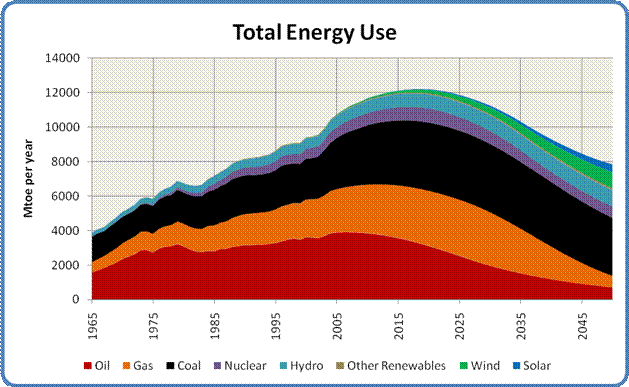
              Image from http://www.paulchefurka.ca/WEAP2/Ene..._GDP_2050.html

              In a few decades we will have less energy and significantly more people competing for it. Food production (grain) and GDP are dependant on energy production.

              Most countries are projected to drop in GDP (except a few cases where they have lower energy intensity of GDP and good internal energy sources.

              If you look at Japan: they have low birthrate, not so much immigration and number of active population has decreased. Some call it a lost decade. I read an article somewhere that they, considering how active population was decreasing, actually had a growth per active person better than US and Eurozone.

              See:


              We are also already seeing high food prices - recent revolutions in north Africa were partially sparked by malcontent of high food prices. Africa is projected to spend 100% of GDP for food imports in a few decades. How grim this is and where this leads to, one can only imagine.

              The 99% movement speaks of end of capitalism and blames banks and politicians but it's really hard to pin blame for World's population growth and energy source depletion on any particular person or group.

              I think future looks like 1920s-1960s (depending on where you live):
              - many people didn't own cars (wealthy will still own them)
              - wood and other things than oil and gas are used to heat houses (in country like Slovenia which is 50% forest, percentage of forest is increasing, this is viable, you can have very high-tech automated wood-fired heating)
              - people will start to produce some groceries and food locally more
              - like dZeus said more local transport. In Czech republic I saw a relict local train which had 2 cars and could take ~50-70 people. It looked more like a bus, kids were going from school with it. In Kazakhstan it costs on the order or 20-30 EUR to cover 1200km by train or by bus (100 EUR for plane) and all trains are booked a few days in advance. In Europe it's not uncommon to be alone in a compartment.

              Recently I did a calculation for person living 30km from Ljubljana daily commuting by car. If the wage is minimum, it's about break-even point for such person to sell the car and be at home on welfare.

              Still we are much better networked (in countries where most people don't have laptops they use smart phones (mostly Nokias with Simbians, rich have iPhones and Androids). A lot of things that previously meant errand can now be done online.


              See also following documentary:


              Arithmetic, Population and Energy
              Last edited by UtwigMU; 26 February 2012, 11:11.

              Comment


              • #8
                Originally posted by Brian Ellis View Post
                Thirdly, pigs the world over are often fed entirely or partially on swill
                One other thing, with over 1,000 insect-species that are edible (and eaten!), I'd be hugely surprised of not some of these could feed on the same.
                Join MURCs Distributed Computing effort for Rosetta@Home and help fight Alzheimers, Cancer, Mad Cow disease and rising oil prices.
                [...]the pervading principle and abiding test of good breeding is the requirement of a substantial and patent waste of time. - Veblen

                Comment


                • #9
                  Originally posted by Brian Ellis View Post
                  As a dedicated carnivore, I disagree.
                  While the thought of eating insects "bugs" me, umfriend has a big point. When considering the amount of calories provided by the food, the means necessary to grow the same amount of nutritional value in insects is much less than for meat (cows, pigs, ...). The main problem with meat processing is related to water and energy usage that goes with it, not with the food the animals eat...
                  pixar
                  Dream as if you'll live forever. Live as if you'll die tomorrow. (James Dean)

                  Comment


                  • #10
                    Another quick thing: bugs don't need antibiotics while the meat industry is responsible for a lot of the immunity to anti-biotics that we face today.
                    Join MURCs Distributed Computing effort for Rosetta@Home and help fight Alzheimers, Cancer, Mad Cow disease and rising oil prices.
                    [...]the pervading principle and abiding test of good breeding is the requirement of a substantial and patent waste of time. - Veblen

                    Comment


                    • #11
                      As range band flocks move within a large area in which it would be difficult to supply a steady source of grain, almost all subsist on pasture alone. This style of sheep raising accounts for most of the sheep operations in the U.S., South America, and Australia[
                      - Not sure about sheep/goat/porc but cows produce quite a bit of aggresive greenhouse gasses
                      True, but a very small fraction of that produced by wild ruminants in Africa alone, from tommies to elephants and an even smaller quantity compared to all the methane that humans allow to be emitted (NG and rice paddies). Also, humans feeding on a vegetarian diet produce more gas than those on a diet which is digested in the way God intended.

                      Tell me which insects you eat regularly as a major component of your diet. Do you think that if insects replaced mammals as a major protein source that they would not require feeding? What is the efficiency of useful protein (muscle) production per hectare compared with mammals (much of an insect's weight is in chitin composites which are indigestible)?
                      Brian (the devil incarnate)

                      Comment


                      • #12
                        Originally posted by Umfriend View Post
                        Another quick thing: bugs don't need antibiotics while the meat industry is responsible for a lot of the immunity to anti-biotics that we face today.
                        Yet! You wait till they are intensively farmed, if your fad catches on.
                        Brian (the devil incarnate)

                        Comment


                        • #13
                          As your source concedes, either they require large areas of pasture or need to be fed. They require a certain amount of soil, either directly or through fed crops, that is large compared to insects.

                          Of course, farming insects would require food for them as well. However the idea is that proportionally they require far less and that stands to reason. E.g., as cold-blooded animals they simply spend far less energy on keeping warm.

                          One study I have seen (granted, by a high-school exam-year student), the soil footprint of cows vs insects (forgot which) was about 5 to 1 on a kg of eadibles. Protein contents in insects is higher than for any meat and it still contains vitamins B, A, essential fatty acids and some minerals.

                          Given the fast reproduction cycle of insects and the many species we could use, anibiotic-use should be avoidable as:
                          - We can more easily switch from one to another species (how many mamals can we raise to feed on)
                          - They become immune themselves within a few generations (just look at how well they do against our insecticides).

                          I eat no insects (aside from what is occasionally processed within our/your food) and find it hard to get my mind to it but we should and I will try. Have tried frozen-dried wurms a couple of days ago. Tasted a bit like peanuts. 5 year old peanuts that is.
                          Join MURCs Distributed Computing effort for Rosetta@Home and help fight Alzheimers, Cancer, Mad Cow disease and rising oil prices.
                          [...]the pervading principle and abiding test of good breeding is the requirement of a substantial and patent waste of time. - Veblen

                          Comment


                          • #14
                            Oh, and about god: read leviticus and tell me god did not intend us to eat insects! Not that I, as an atheist, would care.
                            Join MURCs Distributed Computing effort for Rosetta@Home and help fight Alzheimers, Cancer, Mad Cow disease and rising oil prices.
                            [...]the pervading principle and abiding test of good breeding is the requirement of a substantial and patent waste of time. - Veblen

                            Comment


                            • #15
                              I believe kosher insects are fairly limited, to locusts???

                              Insects may be high in protein, but not assimilable protein, mainly chitin composites.

                              If you look at it from the POV of heat energy, what's wrong with reptiles? Alligators are farmed in the US and crocodiles in the Far East. I have enjoyed both. My one experience with rattlesnake, in Arizona, was mitigated because it was overcooked. I dare say that Large Whip Snake in this country could make a good meal (up to 3 m long and 15 cm diameter), although I've never heard of it being eaten, but Cypriots have a morbid fear of reptiles, even the Agama lizard.

                              As for antibiotics and hormones in animal husbandry, I'm pretty sure you would get analogies (and GMs) in insect husbandry, if it were to become the norm. Mammals can develop immunity as well (cf the development of staph aureus) and require ever-larger doses to combat infections.

                              Oh, and most sheep and goat range band flocks feed on land (mostly hills) that is totally unsuitable for cultivation, so it is a self-fertilising conversion of natural waste biomass to high quality animal protein. In NZ SI, I believe the sheep population in the S. Alps is something like 25 times the human population! In this country, you never see the sheep/goats in fields; they are nomadic in the garrigue/maquis/groves for 10 months of the year and fed on harvested hay/straw in pens for the other two, so they don't use any significant agricultural land (and they are delicious!). I ate the most succulent lamb's kidneys for a lunch snack only yesterday, a gourmet's delight!
                              Brian (the devil incarnate)

                              Comment

                              Working...
                              X